
The Sunday reset has been sold to you as a three-hour ritual with a scented candle in it.
That version does not survive a normal week. It survives one good Sunday in January, photographs well, and is quietly abandoned by February — because a household routine that needs three free hours only runs on the weekends when you did not need it anyway.
The version that lasts is shorter, duller and ruthlessly specific. Thirty minutes, six blocks of five, done in an order that is not arbitrary. It is not a clean. It is the handful of jobs that decide whether Monday morning goes wrong.
Why most Sunday resets die
Nearly every reset routine you will find is a deep clean wearing a different name. Wipe the baseboards, restock the pantry, meal prep five lunches, tidy every room, plan the week, journal about it.
Add it up honestly. Meal prep alone is 60 to 90 minutes. A whole-house tidy with children in the house is another 60. Call the full list three hours, every single week — roughly 156 hours a year, which is nearly four full working weeks spent resetting.
Nobody has that. So the routine gets skipped once, then twice, and then it stops being a routine and becomes one more thing you are behind on.
The rule that follows: a reset should only contain jobs that fail loudly on Monday if they are skipped. Everything else is housework, and housework is not a system — it is just work, and it can happen whenever.
That test cuts the list hard. Baseboards do not fail on Monday. A gym bag still in the wash does.
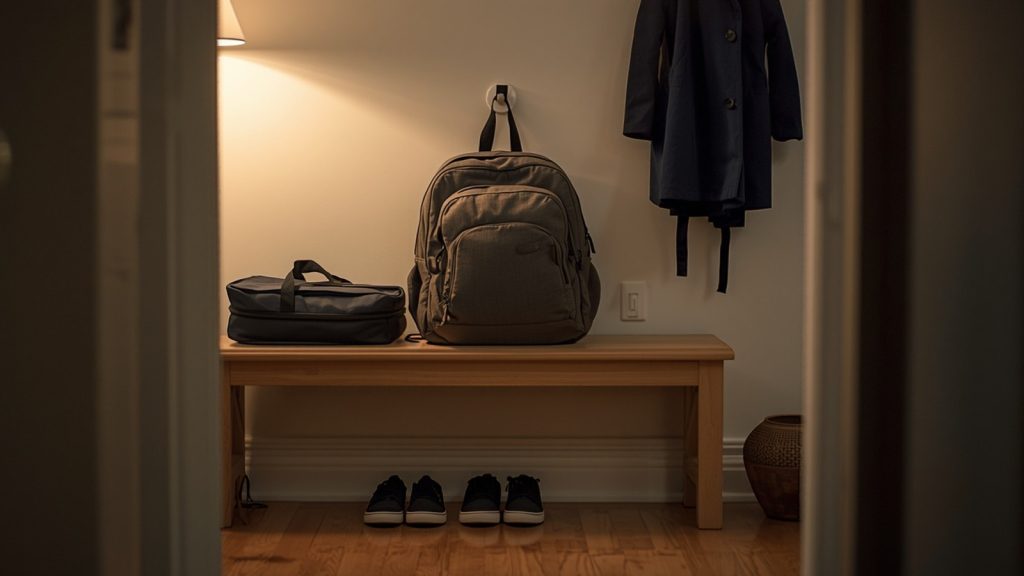
The thirty minutes, in order
Six blocks. Set a timer for each one and stop when it goes off, even mid-job. Stopping on time is the part that makes this repeatable — a block that routinely overruns is a block that needs to be smaller, not a Sunday that needs to be longer.
| Minutes | Block | What actually happens |
|---|---|---|
| 0–5 | The launch pad | Everything that leaves the house tomorrow goes by the door. Bags packed, kit found, shoes paired, permission slip signed and back in the bag |
| 5–10 | This week’s exceptions | Onto the wall: only what is different this week. The dentist, the late finish, the spirit day |
| 10–15 | Kitchen surfaces | Counters clear, dishwasher running, one shelf of the fridge emptied of whatever died in it |
| 15–20 | One load through | Wash on, and the load already clean gets folded and gone. Not all the laundry. One load |
| 20–25 | The paper tray | Every piece gets a decision, not a filing. Bin it, act on it now if it takes two minutes, or put it on the calendar |
| 25–30 | The list | Shopping list finished, and anything the week needs bought or borrowed written down before you forget it |
Thirty minutes, and the house is not clean. That is deliberate. A clean house on Sunday night is pleasant; a found gym bag on Monday morning is the difference between a calm start and shouting up the stairs.

Why the order matters more than the list
The sequence is front-loaded on purpose, and it survives interruption.
If the reset gets cut short — and with a household in the room it often does — you want the failures to happen at the bottom of the list, not the top. Losing the shopping list costs you an irritating extra trip. Losing the launch pad costs you Monday.
So the two blocks that prevent actual Monday-morning failure come first, while the room is still quiet and nobody has changed their mind about what they are doing. The blocks that are merely useful come last, where they can be sacrificed without much damage.
This is the same logic underneath the family command center: the wall holds the exceptions, not a copy of everything. The Sunday reset is the twenty minutes a week that keep that wall true. Without it the board goes stale, and a stale board is worse than no board, because the household has learned not to trust it.

Doing it with the household, not for them
A reset that only one adult performs is not a system. It is a chore with a nicer name, and it will be resented within a month.
The split that works is by block, not by room. One person takes the launch pad and the paper tray. Another takes the kitchen and the laundry. Whoever is left does the wall and the list. Thirty minutes of everyone doing something in parallel is a genuinely different experience from one person doing thirty minutes alone while everyone else watches television.
Two things make it stick:
- Same time every week. Not “Sunday” — an actual time, like six o’clock, so nobody has to be asked. A routine that requires someone to initiate it is a routine that requires someone to nag.
- It ends. The timer going off means finished, including for the person who is not finished. A reset with no defined end is the thing people learn to avoid.
Children can own a block — their own bag, their own shoes, their own kit — and that is a fair share of household work rather than a parenting technique. This site does not do parenting techniques.

When you have ten minutes, not thirty
Some Sundays are gone before you reach them. The reset still runs, at a tenth of the size.
The ten-minute version: the launch pad, and this week’s exceptions onto the wall. That is it. Five minutes each.
Those two blocks carry most of the value, because between them they cover almost everything that produces a bad Monday. The kitchen, the laundry, the tray and the list are all recoverable on a weekday evening. A bag that was never packed is not.
Running the ten-minute version is not failing the routine. Skipping it entirely because you could not face the full thirty is how the routine dies — the same way every over-designed system dies, by making partial credit feel like failure.
The honest bit
A Sunday reset does not give you a calm week. It gives you a week whose problems are the real ones rather than the manufactured ones.
It will not fix a household that is genuinely over-committed. If five evenings out of seven have something scheduled in them, no amount of Sunday preparation makes that sustainable, and thirty tidy minutes will just make an unmanageable week start neatly. That is a different problem, and it is solved by removing something, not by organizing it better.
It also takes about a month to feel like anything. The first two Sundays feel like extra work, because you are still building the launch pad from scratch each time rather than maintaining one. Somewhere around the fourth week the blocks start finishing early, and that is the point at which it stops being effort.
And it does not replace the rest of the housework. It is not supposed to. It is the thirty minutes that protect the other hundred and sixty-seven hours from starting badly.
If you have not built the wall yet, start with the command center — the reset has somewhere to put its output. If you want the wider picture of how these pieces fit together, that is the Family Life OS. The rest of the systems live in Life Systems.